

A Case for Periodic Road Resealing

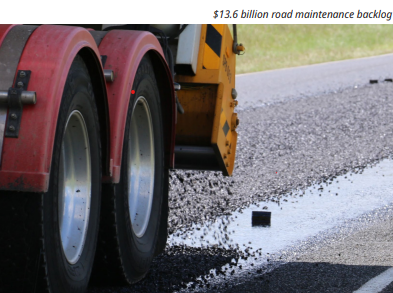
Australia’s road maintenance backlog has reached $13.6 billion, and it is growing. Resealing rates have declined across local, state, and territory jurisdictions for more than a decade.
The consequences are now visible: deteriorating road surfaces, pothole backlogs, and reconstruction costs that far exceed what timely preventative maintenance would have required.
The Australian Flexible Pavement Association (AfPA) is the peak body for Australia’s flexible pavement industry. Founded in 1969, AfPA represents the full supply chain, asphalt producers, bitumen suppliers, sprayed surface operators, equipment manufacturers, state road authorities, and local councils, together building and maintaining approximately 470,000 kilometres of paved road, underpinning a transport sector that contributes $236 billion to the national economy each year.
What is resealing?
Resealing is the application of a new layer of binder and aggregate to the road surface, restoring its function, protecting the underlying pavement layers, and reducing the need for full structural rehabilitation.
The lifespan of a spray seal is anywhere between 10–15 years depending on seal type, traffic conditions, location and climate.
Unlike reactive maintenance, which addresses defects as they emerge, periodic resealing is a planned, preventative intervention, widely accepted as one of the most cost-effective tools available to road agencies.
The principle is best understood through an analogy most Australians will recognise. The bituminous seal is the waterproofing paint on a weatherboard home. Applied on schedule, it protects the timber beneath at manageable cost. Defer that cycle, and moisture penetrates until eventually the entire cladding requires replacement at many times the original cost.
Roads follow the same logic: maintain the seal on time, and the pavement performs reliably for decades; miss the window, and only the most expensive remedy remains.
Why deferral costs more
The evidence is consistent across decades of research and multiple jurisdictions. When maintenance is postponed, costs compound rapidly; a treatment that is cost-effective today can multiply several times over within a few years and escalate further still if deferred until structural failure becomes unavoidable.
The widely cited 1-3-6-9 rule puts a number on it: treatment costing $1 at the optimal point can cost $3 to $6 if deferred several years, and $9 or more once structural failure is unavoidable.
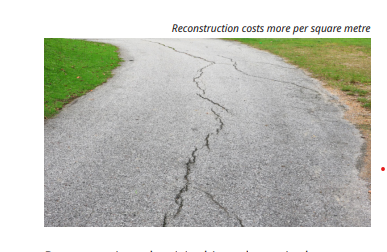
Reconstruction, when it is ultimately required, can cost many times more per square metre than timely resealing. The Victorian Auditor-General has documented this directly for Australian councils: reconstruction costs more than six times as much per
square metre as resealing.
Across the full lifecycle of a pavement asset, periodic resealing consistently delivers significant cost savings and materially extends serviceable life.
Periodic resealing target
This lifespan establishes the industry benchmark: a minimum of 7 per cent of the road network should be resealed annually to maintain network condition. Best practice organisations currently target 10 per cent.
Resealing programs have historically achieved this benchmark; however, the current decline across local, state, and territory jurisdictions is creating a direct case study in the consequences of falling below it: accelerating deterioration (i.e., potholes), rising reactive repair costs, and a growing backlog of avoidable reconstruction.
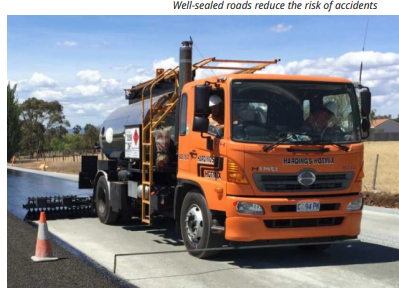
A well-maintained road network underpins economic productivity, keeping freight moving efficiently and reducing the costs of congestion and delay. It supports public safety; well-sealed roads reduce the risk of accidents and trauma. It strengthens climate resilience, protecting infrastructure against extreme weather. And it reflects sound fiscal responsibility; timely maintenance consistently costs less than deferred rehabilitation.
AfPA’s white paper calls on governments to commit to a minimum 7 per cent annual reseal program and to publish thattarget;the most cost-effective, deliverable infrastructure investment available to Australian governments today.
The path forward
Improving Australians roads begins with taking care of what already exists. The evidence, Australian and international, technical and economic, converges on a single conclusion: periodic resealing applied on time, at most cost-effective infrastructure investment available to Australian governments.
Continue current trajectories where resealing rates have fallen below the benchmark, and accept exponentially compounding reconstruction costs, declining network condition, growing safety risks, reduced freight productivity, and rising vulnerability to
extreme weather.
Or commit to restoring periodic resealing programs to industry-benchmark levels, with best-practice jurisdictions targeting 10 per cent, and capture the lifecycle cost savings, safety gains, freight productivity, and climate resilience that follow. The decision, and the road network Australians inherit, begins here.
More information
www.afpa.asn.au
[email protected]
PO Box 4857, Eight Mile Plains, QLD4113