
Pyrenees Quarries talks with CMPA
Challenges facing the stone industry
Many major government projects in Victoria specify Harcourt granite and Adelaide black granite but often use material from China because it’s cheaper and supply can be quicker.
“Some of these are very big projects, like the suburban rail link and over passes that specify Australian stone, which we quote on – then what happens, is they receive our quote and go to China for something equivalent that is cheaper and quicker,” said Glenn Guest, Pyrenees Quarries.
- Premium civic appearance,
- Durable stone with proven performance,
- And a “local Australian materials” story.
In practice, project specifications and procurement decisions often do not align. Architects, planners, and governments often try to achieve:
However once contractors bid and delivery starts, commercial pressures take over.
“Large projects should be done here using local granite and Australian stone. When money goes to China, the money has gone for good – here, it stays here and goes around until it is all back in tax.”
Chinese stone suppliers can usually produce and fabricate granite far cheaper because they operate at enormous industrial scale, including:
- Lower labour costs
- Lower occupational health and safety, and
environmental standards - Massive, automated factories,
- Integrated quarry-to-fabrication systems,
- Cheaper processing, and
- Lower per-unit transport costs.
Even after shipping to Australia, finished stone can still cost much less than locally quarried and fabricated stone.
“Australian quarries pay tax, transport and freight pays tax, employees pay tax and we pay tax on any profit.
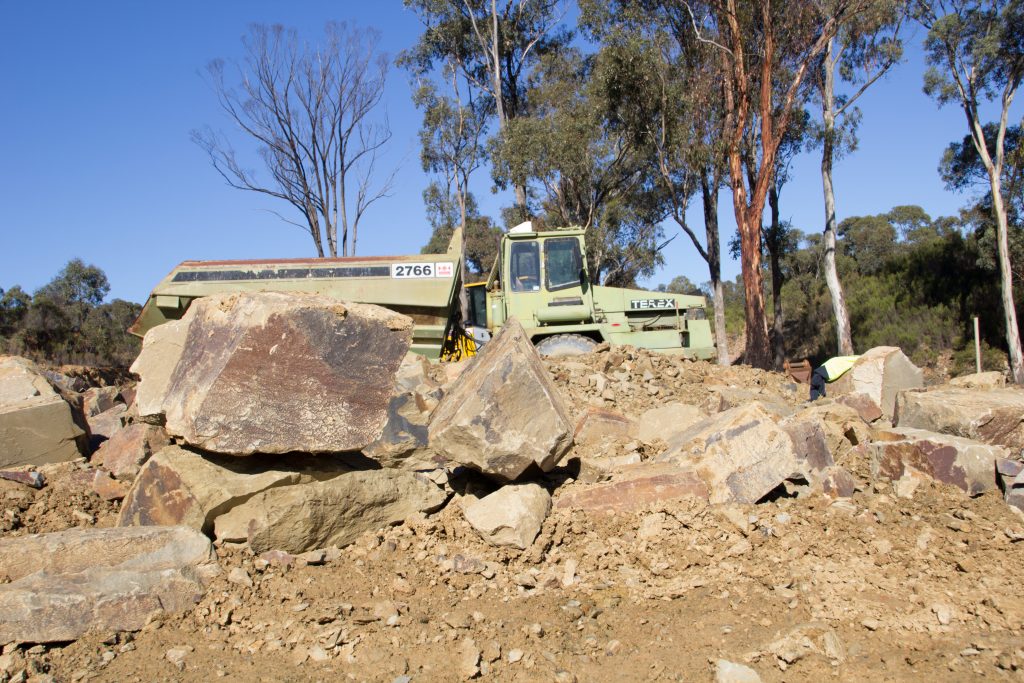
Yapeen Quarry
When we spend the profit, it is taxed again until it’s all tax that can then be reused on another project to benefit Australia.”
Australian quarries operate under rigorous and stringent regulations to manage environmental, community and public health and safety risks, just to name a few. They face mandatory, site-specific licensing and ongoing compliance requirements
including Work Authority and Planning permit approvals, environmental management, native vegetation, rehabilitation bonds, Aboriginal Heritage, occupational health and safety etc.
“With all the red tape and regulation that we are subject to, particularly in Victoria, it’s only a matter of time before we really start to import aggregates because we can’t supply enough here.”
When the government awards a project to a company, the stone should be ordered well in advance, to allow for quarrying of material and processing, so that it can be delivered on time, without delays.
“There used to be a lot more businesses like ours in Victoria that are no longer operating, like Melocco and Layton’s. It seems like they deliberately delay ordering, so they can use the excuse that we can’t supply in the time frame.”
Increasingly, it seems that contractors value economics, quantity and fast turn-around-time over high-quality locally sourced stone, traceability and country of origin. The original named stone in a
contract is often more of a design reference than a strict sourcing requirement.
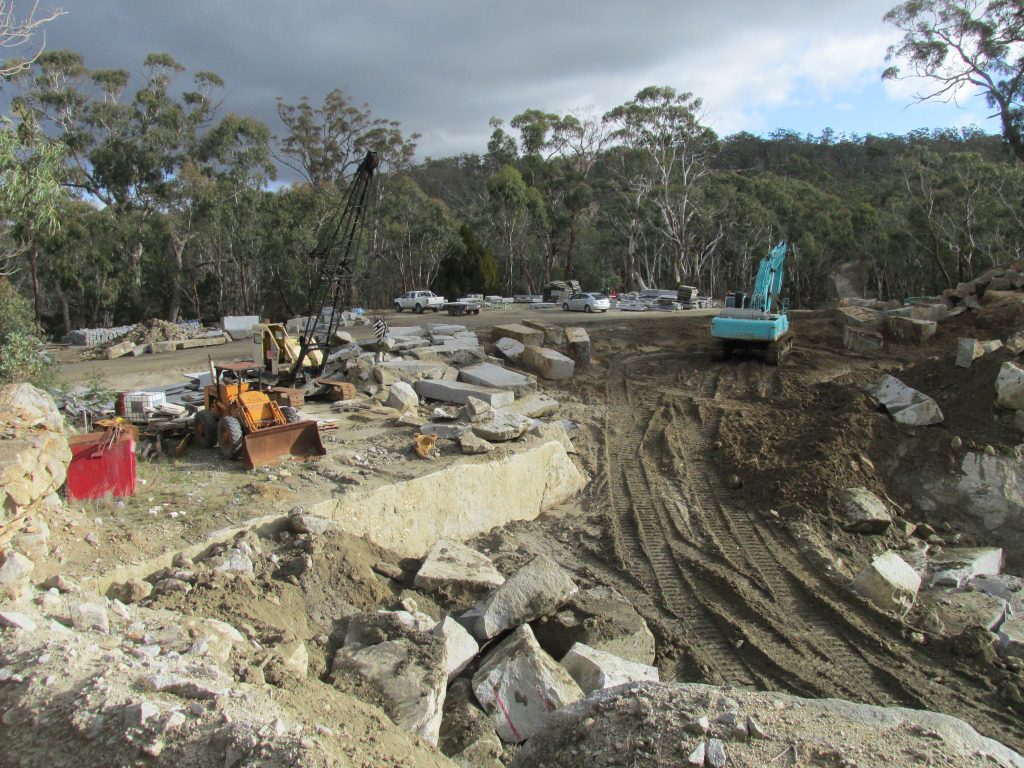
Harcourt Granite Quarry
Governments often promote “local materials” publicly, but contracts are usually written to preserve flexibility and avoid:
- Budget blowouts
- Procurement disputes
- or trade issues
In practice, what often occurs is that local stone is specified as the benchmark, then contractors obtain pricing, procurement teams search offshore and source materials cheaper and faster.
“What we need, is a united front, where all the stone companies in Australia come together and expose what is really happening behind the scenes – providing quotes for government projects, only for material to be purchased from China.”
Pyrenees Quarries has been a CMPA Member for more than 20 years. We thank them for their support and representing the interests of small to medium businesses in the quarry industry.